Secure Platform Integration Is Not Plumbing
Why enterprise integration layers are control surfaces for workflow correctness, identity, observability, and recovery.
Integration layers are where identity, data quality, workflow semantics, and recovery become explicit. Treating them as plumbing is how modernization programs lose control.
Architecture Control Boundaries
Part 1 of 3
Problem statement
Integration work is often treated like a narrow technical chore: map a few fields, move some records, and declare the systems connected. That view is too small. The integration layer is where identity gets translated, workflow state changes hands, upstream data quality becomes visible, and recovery paths either exist or do not.
In modernization programs, this layer is also where operating risk accumulates. The moment multiple systems share responsibility for a process, the integration path becomes a control surface for correctness, observability, and operational recovery.
Secure platform integration is not plumbing. It is the place where data contracts, trust boundaries, workflow semantics, and failure handling must become explicit.
Why integration fails in modernization programs
Programs usually fail here for ordinary reasons, not exotic ones. Teams assume the source systems are better defined than they are. A delivery plan focuses on feature parity while leaving state reconciliation, retries, identity mapping, and operator visibility for later. The result is an integration layer that moves data but cannot explain whether the business process is actually healthy.
This gets worse when the integration path is built inside a single vendor implementation mindset. Once orchestration rules, security decisions, and business corrections collapse into one integration path, replacement gets more expensive and defects get harder to isolate.
Layered control model
The useful pattern is a layered one: contract and identity at the ingress boundary, workflow mediation in the application layer, durable event and observability records around the transaction, and explicit recovery tooling for operators.
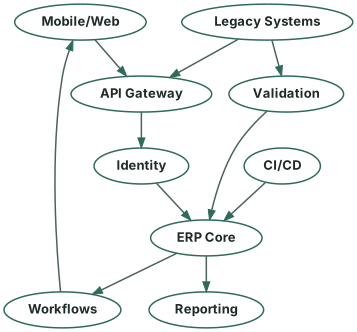
The diagram forces the questions that matter: where is identity asserted, where is state normalized, where are business decisions made, and where do operators go when a transaction is partial?
Common failure modes
- Field mapping succeeds while workflow semantics drift, so records exist in both systems but represent different business states.
- Retry logic duplicates side effects because idempotency and replay keys were never designed into the path.
- Identity and entitlement assumptions leak across systems, creating authorization gaps that are hard to audit later.
- Monitoring focuses on transport errors while silent data-quality failures continue downstream.
- Recovery depends on ad hoc scripts and institutional memory instead of designed operator workflows.
Practical controls
- Define versioned interface contracts and keep contract validation at the edge rather than distributing it across consumers.
- Separate transport adapters from business workflow rules so the integration layer can survive vendor or platform change.
- Carry correlation IDs, provenance markers, and actor identity across every transaction boundary.
- Make idempotency, replay, and compensating actions explicit design features rather than operational folklore.
- Give operators first-class recovery tools and clear state models for partial failure.
The follow-on concern is how new AI-assisted paths fit inside those same controls. That is the subject of AI Pipelines Need Control Boundaries.
Conclusion
Integration layers deserve architectural attention because they decide whether modernization produces a governable system or just a more complicated failure surface. When teams treat integration as a control boundary instead of a wiring task, they get clearer workflow behavior, better recovery, and more realistic options for later change.