Software Layers Are Risk Boundaries
Why layered architecture keeps business rules, integration boundaries, security decisions, and runtime concerns from collapsing into each other.
Layering is how mobile, integration, and AI-enabled systems stay governable when vendors, channels, and runtime concerns change around them.
Architecture Control Boundaries
Part 3 of 3
Why layers still matter
Layered architecture matters because it is one of the simplest ways to keep risk from collapsing into a single code path. Without layers, interface concerns, business rules, integration behavior, and infrastructure choices drift together until every change becomes a coupled change.
The useful question is not whether the layers are academically pure. It is whether they preserve replaceability and make failure easier to localize.
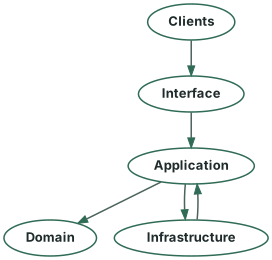
Clients and channels
Mobile apps, browser clients, partner interfaces, background jobs, and operator tools all enter the system from different conditions. Their job is to collect intent and present results. They should not become the place where core workflow rules are defined.
Interface layer
The interface layer translates between external protocols and internal use cases. It handles transport concerns such as request validation, authentication context, response shaping, and correlation identifiers. It should not be the home of domain policy.
Application layer
The application layer coordinates workflows. It decides what needs to happen in what order, which policies apply, and which collaborators need to be invoked. This is where enterprise process shape belongs, including AI-assisted steps, approval gates, and integration sequencing.
Domain layer
The domain layer protects business meaning: state transitions, invariants, eligibility rules, and the definitions that make the system more than a collection of endpoints. It should remain understandable without reference to a UI framework, ERP connector, or model provider.
Infrastructure and adapters
Infrastructure is where databases, queues, vendor SDKs, ERP connectors, mobile platform services, and model providers live. These adapters are necessary, but they should remain replaceable. When they leak upward into policy code, vendor replacement becomes a rewrite instead of an integration task.
Why each layer exists
- Clients and channels isolate user-facing behavior and device-specific constraints.
- The interface layer protects the system from protocol churn and input ambiguity.
- The application layer governs workflow sequencing and approvals.
- The domain layer preserves business rules independent of tools and vendors.
- Infrastructure and adapters keep external systems attached without turning them into the center of the design.
Why this helps in real programs
On mobile programs, it keeps device and channel concerns from taking over core business logic. In system integration and enterprise modernization work, it prevents a vendor interface from becoming the architecture. In AI-enabled workflows, it creates a safe place for retrieval, reasoning, and validation without promoting the model to system authority.
It also supports replacement. A mobile client can be rebuilt, an ERP connector can be swapped, or an AI provider can change without forcing a redesign of the domain. That is the point of keeping the boundaries clear.
The operational side of that same argument shows up in Secure Platform Integration Is Not Plumbing, where the integration layer is treated as a control surface rather than a transport detail.
Conclusion
Software layers are not only a code-organization preference. They are risk boundaries. They decide whether business rules stay durable, whether integrations remain replaceable, and whether runtime concerns can change without pulling the whole system apart.